
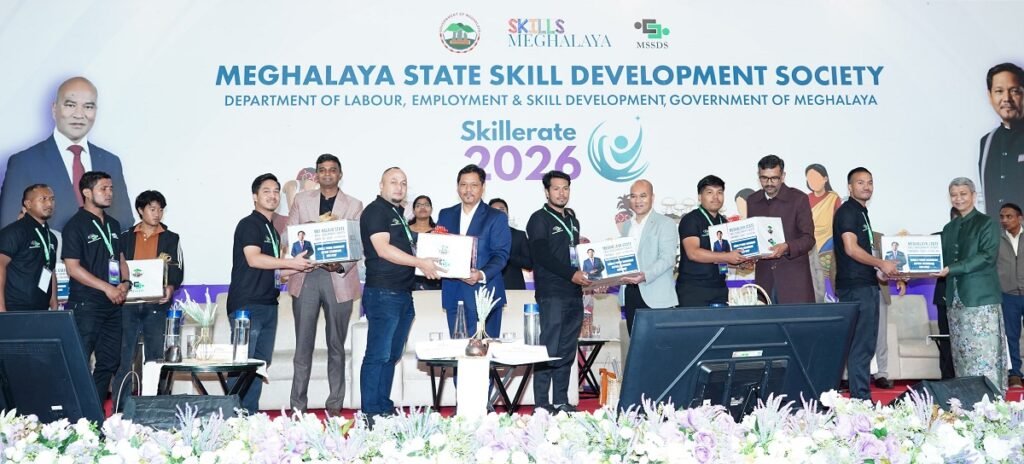
Meghalaya Chief Minister Conrad K. Sangma today attended Skillerate 2026 at NEHU, Shillong, where he launched four new initiatives aimed at strengthening Meghalaya’s skill development ecosystem and expanding employment and entrepreneurship opportunities for the youth of the State.
The programme was organised by the Department of Labour, Employment and Skill Development, Government of Meghalaya, in collaboration with Skills Meghalaya and the Meghalaya State Skill Development Society (MSSDS).
The launch of four flagship initiatives under Skills Meghalaya includes PROPEL, which supports trained youths after training through startup toolkits, mobility support, salary augmentation, marketing assistance and industry linkages; MEGASKILL, which prepares youth to compete from district to international level, culminating in participation in the WorldSkills Competition in Japan 2028; SHIELD, which focuses on structured training, certification, placement support and dignified employment in homecare services; and EQUIP, which promotes inclusive skilling for persons with disabilities and other vulnerable groups to ensure equitable access to opportunities.
Addressing the gathering, Chief Minister Sangma described the programme as one of the most important initiatives of the Government, stressing that livelihood creation remains the State’s biggest challenge.
He noted that Meghalaya’s young demographic profile makes this challenge even more significant.
“Meghalaya is a young state, where nearly 50 percent of our population is below the age of 20. Every year, approximately 60,000 young individuals enter the workforce. This number is expected to grow further in the coming years. Therefore, the creation of sustainable livelihoods and jobs is, and will continue to be, the most critical challenge for us as a government,” he stated.
Explaining the rationale behind a State-led skilling model, he said national programmes, while important, often require localisation. “We have found that state-specific needs sometimes require more focused and tailored interventions. This is why we decided to design our own skill programme—one that is funded by us, tailored to our requirements, and flexible enough to evolve as needed,” he said.
He also acknowledged the role of development partners, stating that close to 50 percent of the funding comes from an externally-aided project supported by the Asian Development Bank (ADB).
Addressing concerns over such funding, he clarified, “Nearly 80 percent of this funding is repaid by the Government of India. The financial burden on the state is minimal, while the benefits are substantial and visible.”
Highlighting outcomes of the programme, he said thousands of youths have already benefited. “Because of these externally aided projects, thousands of our youth have been trained. These are real, tangible outcomes—transforming lives, creating opportunities, and generating employment,” he said.
The Chief Minister further emphasised that youth aspirations are diverse and the skilling ecosystem must reflect that. “Our youth have diverse aspirations. Some wish to remain in their villages and work close to home. Some aspire to move to cities within the country. Others aim to work abroad. Each of them, however, seeks a dignified livelihood,” he said.
Speaking on the newly launched initiative, he said the programme addresses a critical gap identified through feedback. “We realised that while skill training and certification were being provided, many beneficiaries lacked the necessary tools and support to effectively use their skills for livelihood generation. This programme is a direct response to that gap,” he said.
He added that toolkits will be distributed according to trades, including specialized kits for tour guides, plumbers, and technicians. The initiative will benefit nearly 21,000 trainees, with an estimated expenditure of around Rs 24 crore for toolkits alone.