
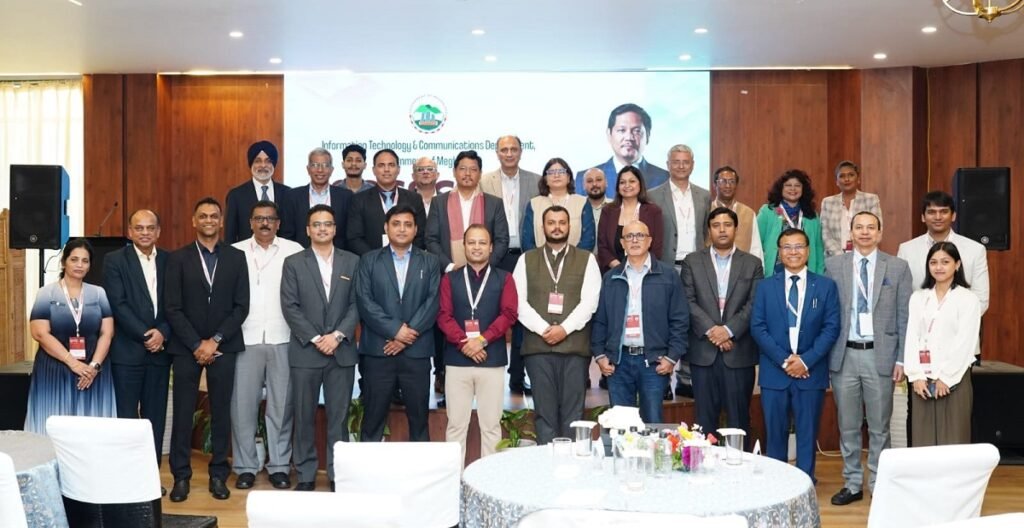
The NASSCOM Industry Leaders’ Meet 2026 was held at the State Convention Centre in Shillong on Thursday. organised by the Information Technology and Communications Department, Government of Meghalaya in collaboration with NASSCOM.
The event brought together leading industry representatives, technology companies, and senior officials to deliberate on strengthening Meghalaya’s position in the digital economy, expanding IT-enabled services, and enhancing skilling and employment opportunities for local youths.
As part of the programme, an agreement signing ceremony was held between StaffFlex Resolutions LLP and the Meghalaya Technology Parks Society for the leasing of space at Shillong Technology Park–II, marking the first confirmed occupant of the facility. The signing represented a significant milestone in operationalising the State’s expanding IT infrastructure and reinforcing investor confidence in Meghalaya’s emerging technology ecosystem.
Chief Minister Conrad K. Sangma, who witnessed the signing and addressed the gathering prior to the Round Table discussion, noted that the development of the IT sector in Meghalaya has been a long-term, gradual process requiring sustained effort and ecosystem-building.
He stated that the journey of developing the sector has been gradual and shaped by years of persistent effort, saying, “I have been trying to build this momentum for many, many years. Things take time. It is not as if everything happens at once, but when I look back at the journey, it has now been 18 years since I first had the opportunity to engage with this sector during my tenure as IT Minister in 2008, when I was part of the government for a year.”
Reflecting on the intervening years, he noted that progress had been limited during a certain period, but emphasised continuity in intent and focus. “After that, for almost 10 years, nothing really moved forward. I do not blame anyone, and I am not making a political statement. It is simply that things did not progress during that period. Then, when I returned as Chief Minister in 2018, we began working again in a focused manner on building the IT sector and strengthening the ecosystem,” he said.
Highlighting the State’s ongoing infrastructure push, the Chief Minister noted that key investments are now materialising on the ground. “Today, we are happy that the second IT Park is ready, and another one is coming up in Tura. From the very beginning, I have always believed that technology, or any sector, cannot be viewed only through a narrow lens of competitive advantage. You have to build an ecosystem for the industry to survive and thrive. That is what we are trying to do,” he added.
Addressing industry partners, training institutions, and stakeholders present, he underscored the importance of collective responsibility in building the ecosystem. “All of you who are present here today, especially our local training partners, have a very important role to play. The objective of organizing this programme is to connect all of you and help you understand the opportunities that are unfolding both nationally and globally, and how Meghalaya can be part of that story,” he said.
He further stressed that sustainable growth requires collaboration across all stakeholders. “However, there are things that need to be done collectively—by the government, by partners, by stakeholders, and by individuals. That initiative has to come from all of us. The entire purpose of this programme today is to send a clear message that, as a government, we are committed to making this happen,” he stated.
Reaffirming the Government’s long-term commitment, he added, “I am not saying that we can do everything—we cannot. But what I want to assure you is that we will walk the long journey with you, support you in every possible way, and move together in the right direction.”
The Chief Minister also invited suggestions and continued engagement from industry partners. Emphasising a pragmatic and results-driven approach, he said, “It is important that we are focused and realistic in what we want to achieve. We are not interested in signing MOUs just for the sake of optics or photo opportunities, where many agreements are signed but nothing materialises afterwards. I am not a big fan of that approach.” He further added that the focus must remain on meaningful and sustainable outcomes.
Concluding his remarks, the Chief Minister expressed appreciation for the participation of all stakeholders and acknowledged the engagement of the NASSCOM leadership. “Your presence here encourages all of us, and I hope we will have many more such meaningful engagements in the future.”
Meanwhile, the Round Table interaction with industry leaders from the BPM, IT, and technology ecosystem was chaired by Chief Minister Conrad K. Sangma, where representatives from across the country shared detailed suggestions on strengthening Meghalaya’s emerging digital economy and startup landscape.
The discussion, held under the framework of engagement with NASSCOM and industry partners, focused on converting the State’s long-term IT and innovation vision into actionable policy and implementation pathways. Industry participants proposed a set of priority interventions, including the creation of a signature innovation hub modelled on leading incubation ecosystems, the establishment of a high-level startup task force, and the need for structured policy acceleration to scale the startup base in the State.
Several speakers highlighted the importance of learning from successful models in other states, particularly in rapidly expanding startup ecosystems, and suggested that a consolidated best-practices framework or white paper could help Meghalaya adopt proven approaches more quickly. The Chief Minister, in response, welcomed the idea of a structured roadmap and indicated openness to a collaborative document that can guide measurable action over the coming months.
A strong emphasis was placed on skilling and future-ready workforce development, with industry leaders cautioning that BPM and IT service roles are rapidly evolving due to automation and artificial intelligence. Participants also recommended integrating emerging competencies such as cognitive AI systems, prompt engineering, digital fundamentals, cyber hygiene, and domain-specific compliance skills into academic curricula. The need for stronger industry–academia linkage and anticipatory skilling—aligned to future job profiles rather than current demand—was repeatedly underscored as critical for long-term sustainability.
The participants also discussed ease of doing business, highlighting the importance of defined turnaround times for regulatory clearances, stronger single-window systems, and predictable compliance mechanisms for companies setting up operations in the State.