
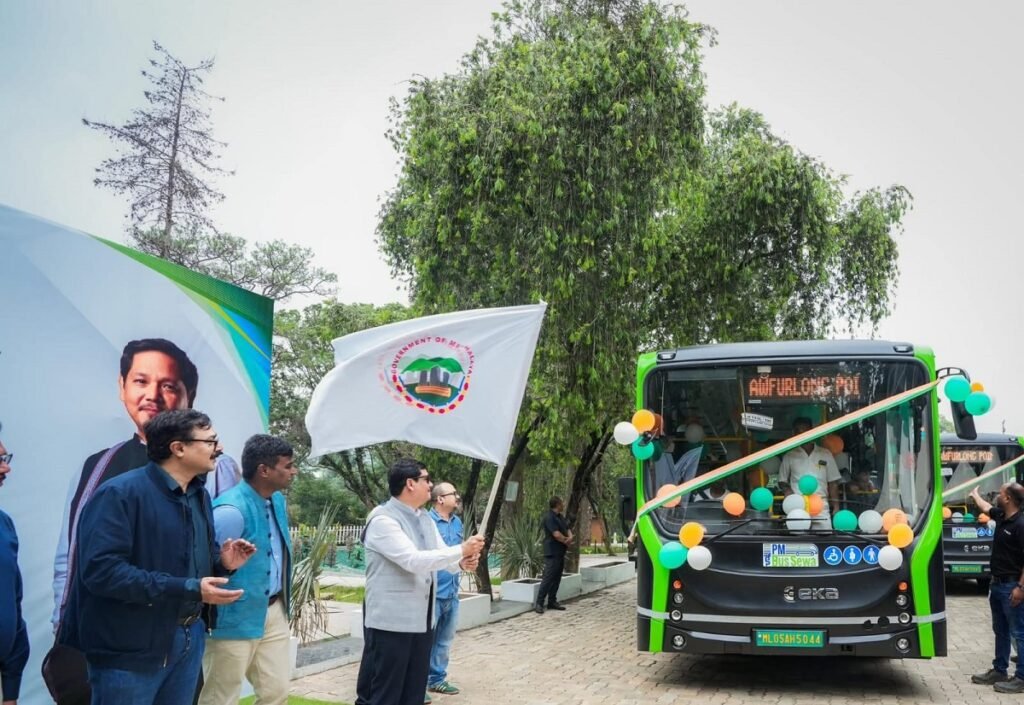
Meghalaya Chief Minister Conrad K. Sangma on Tuesday flagged off five electric buses under the PM eBus Sewa Scheme in Shillong, marking a significant step towards promoting sustainable urban mobility and strengthening public transport infrastructure in the State.
The newly launched buses are fully air-conditioned, zero-emission vehicles capable of covering nearly 180 to 200 kilometres on a single charge and are equipped with wheelchair spaces, foldable ramps, overhead storage facilities and e-ticketing systems to ensure accessible and commuter-friendly services.
The Chief Minister said the initiative forms part of the Government’s broader strategy to reduce congestion in Shillong .
Thanking Prime Minister Narendra Modi and the Government of India for supporting the PM eBus Sewa Scheme, Sangma said the Government has been experimenting with various mobility solutions over the years. “Slowly but steadily, we are arriving at a model that is more adaptable and tailor-made for the needs of our city,” he said, adding that the ultimate objective is to decongest Shillong and reduce dependence on private vehicles.
The Chief Minister further said that the electric bus initiative is linked to a larger urban development roadmap that includes new parking infrastructure and the upcoming administrative city at Mawdiangdiang, which is expected to ease pressure on Shillong’s urban core. He also reiterated the Government’s commitment to promoting electric mobility and informed that the policy providing exemptions on registration fees and road taxes for electric vehicles would soon be renewed.
Sharing his own experience as an EV user, Sangma said electric vehicles are well-suited for Meghalaya’s terrain and encouraged citizens to adopt cleaner modes of transportation.
Earlier, Dr. Vijay Kumar D, IAS, Commissioner and Secretary, Urban Affairs Department, informed that Shillong has been sanctioned 50 electric buses under the PM eBus Sewa Scheme and that the city is transitioning towards a Gross Cost Contract model under which operators are paid based on service standards rather than fare collection. He said the buses are GPS-enabled and operate on fixed schedules, while daily ridership on the recently introduced diesel bus services has already increased from around 300 passengers to nearly 3,000 passengers per day.