
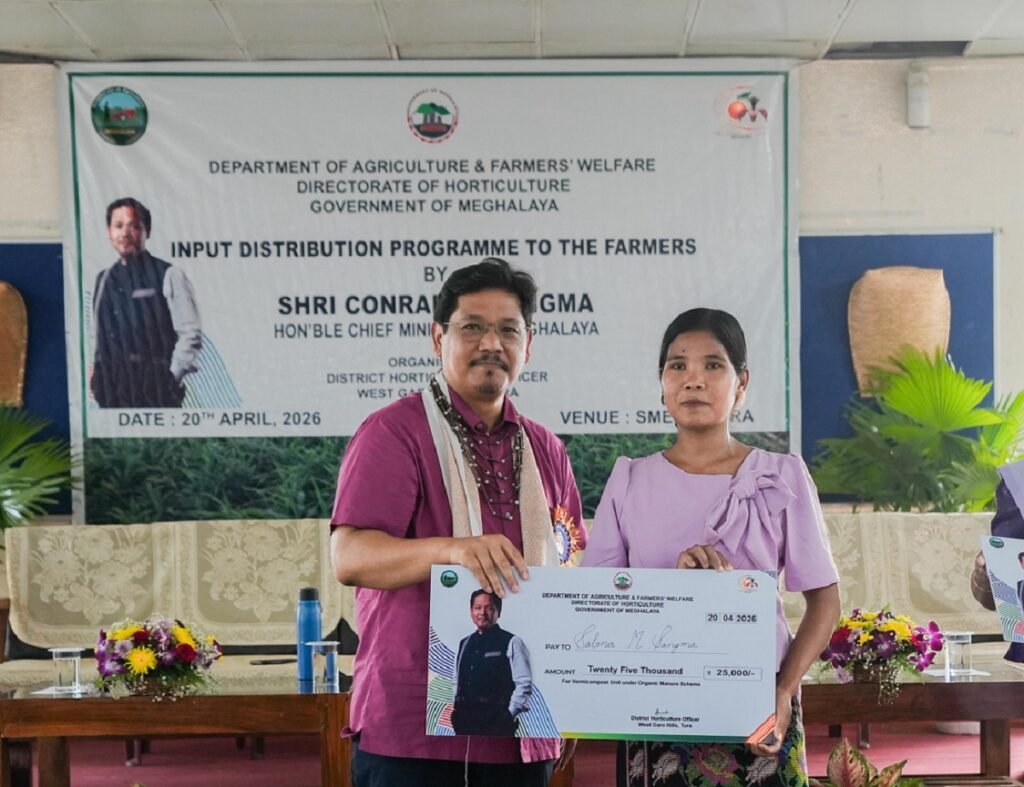
The Department of Agriculture and Farmers’ Welfare, Directorate of Horticulture, Government of Meghalaya, organised an Input Distribution Programme for farmers and community institutions in Tura.
Meghalaya Chief Minister Conrad K. Sangma attended the programme as chief guest.
The programme focused on the convergence of key agricultural and horticultural schemes to enhance productivity, promote sustainable practices, and strengthen farmer livelihoods.
Addressing the gathering, the Chief Minister reiterated the Government’s commitment to improving farmers’ income through targeted interventions, value addition, and sustainable agricultural practices.
Sangma stated that agriculture continues to be the backbone of the State’s economy, with over 70 percent of households engaged in farming and allied activities.
“More than 70 percent of our households are directly or indirectly dependent on agriculture. Therefore, every intervention we make in this sector directly impacts the lives and livelihoods of our people,” he said.
Highlighting the Government’s efforts, the Chief Minister said that various schemes and programmes are being implemented to support farmers and self-help groups by enabling them to upgrade skills, enhance productivity, and add value to their produce.
“Through our different initiatives, we are not only supporting farmers individually but also strengthening self-help groups so that they can upscale their activities and improve incomes,” he added.
Referring to key challenges, Sangma noted that timely access to quality seeds has been a major concern for farmers. “One of the biggest challenges faced by our farmers has been the lack of timely availability of good quality seeds. This is why we are taking this up in a mission mode to ensure that every farmer receives the right inputs at the right time,” he said.
Speaking on the Ginger Mission, he noted that the Government has invested over Rs 62 crore since 2022, benefitting more than 19,000 farmers across the State, and that the programme will be further expanded to cover over 15,000 additional farmers.
He emphasised that the initiative is aimed at reviving Meghalaya’s position as a leading ginger-producing state.
The Chief Minister also highlighted the distribution of support under the Organic Manure Scheme. “Today, we are also distributing cheques for low-cost vermicomposting units. This will help farmers become self-reliant in organic manure and reduce dependency on external inputs,” he said.
Underscoring the importance of value addition, he spoke about the growing network of food processing units in the State. “Processing is key to increasing farmers’ income. Through these food processing units, we are ensuring that farmers get better value for their produce and access to larger markets,” he stated.
He further informed that a major ginger processing unit is nearing completion. “The largest ginger processing unit in the State, with a project cost of about ₹20 crore, will soon be inaugurated in Ri Bhoi. This facility will benefit nearly 10,000 ginger farmers by providing assured market linkages and better returns,” he said.
Encouraging farmers to make full use of the support being extended, he added, “I urge all our farmers to take advantage of the schemes and inputs being provided today. These initiatives are designed to support you in improving productivity, enhancing income, and ensuring long-term sustainability of your farming activities.”
During the programme, inputs were distributed under multiple schemes, including the Ginger Mission, distribution of dummy cheques to beneficiaries for the establishment of vermicomposting units under the Organic Manure Scheme, and distribution of vegetable seed kits to Anganwadi Centres under the Vegetable Development Scheme.
The Ginger Mission, launched in 2022, aims to revive Meghalaya’s position as a leading ginger-producing state. The Government has invested over Rs 62 crore under the mission, benefitting more than 19,000 farmers.
In 2026–27, an additional Rs 15 crore is being invested to cover over 15,000 farmers, with each beneficiary receiving 100 kg of quality ginger seed free of cost, valued at approximately Rs 8,000.
The establishment of ginger processing units in the State has further supported value addition and contributed to improving farmers’ livelihoods.