
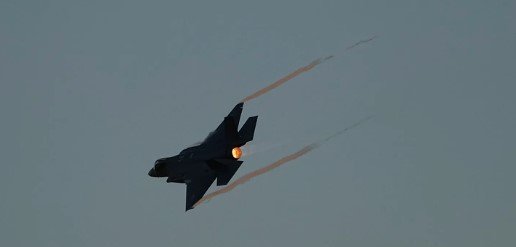
In a stunning development that has sent shockwaves through the global defense community, unconfirmed reports suggest that a Lockheed Martin F-35 Lightning II—the world’s most advanced stealth fighter—may have been intercepted or downed during a high-stakes reconnaissance mission over Iranian airspace. While the Pentagon has yet to officially confirm the loss of the airframe, leaked intelligence and local footage indicate that the “invisible” jet may have fallen victim to an ingeniously simple, low-tech countermeasure that exploited the very technology designed to make it invincible. Military analysts are calling this a classic case of a “high-tech solution backfiring against a low-tech problem,” as Iran appears to have utilized a decentralized network of passive acoustic sensors and VHF-radar arrays to track the thermal and wake turbulence of the aircraft rather than its radar cross-section. The F-35 is engineered to be invisible to X-band and S-band radars used by traditional surface-to-air missile systems, but its reliance on complex electronic warfare suites may have created a distinct “electronic shadow” that allowed Iranian ground forces to triangulate its position using archaic yet effective tracking methods.
This potential incident highlights a critical vulnerability in modern Western air doctrine, which prioritizes stealth and network-centric warfare over raw speed and maneuverability. If the reports are accurate, the F-35 was likely operating in a “beast mode” or high-frequency emission state to jam local communications, unknowingly acting as a digital flare for Iranian observers. By integrating ancient radio technology with modern AI-driven signal processing, Tehran may have developed a “low-cost, high-impact” net that renders multi-billion dollar stealth programs surprisingly fragile. The irony of the situation is profound: the more “hi-tech” the aircraft becomes, the more it relies on a pristine electromagnetic environment to function; once that environment is cluttered with low-frequency noise and passive detection, the stealth advantage evaporates. This “backfire” effect suggests that the F-35’s sophisticated onboard computers may have misclassified the low-tech signals as harmless background interference, allowing the Iranian defense systems to close the gap before the pilot could deploy kinetic countermeasures.
The broader implications for international security are immense, as this event could force a total reassessment of air superiority strategies across the NATO alliance. If a “rogue state” using off-the-shelf components and decades-old radio physics can neutralize a fifth-generation fighter, the massive financial investments in stealth technology may face unprecedented scrutiny. For now, the wreckage—if it exists—remains a highly coveted prize, with Russian and Chinese experts reportedly scrambling to assist Iran in analyzing the debris. As the U.S. military conducts an urgent review of its stealth protocols, the incident serves as a grim reminder that in the theater of war, the most sophisticated shield can often be shattered by the simplest of stones. The world now waits to see if this was an isolated mechanical failure or the definitive proof that the era of uncontested stealth dominance has come to a violent end.