
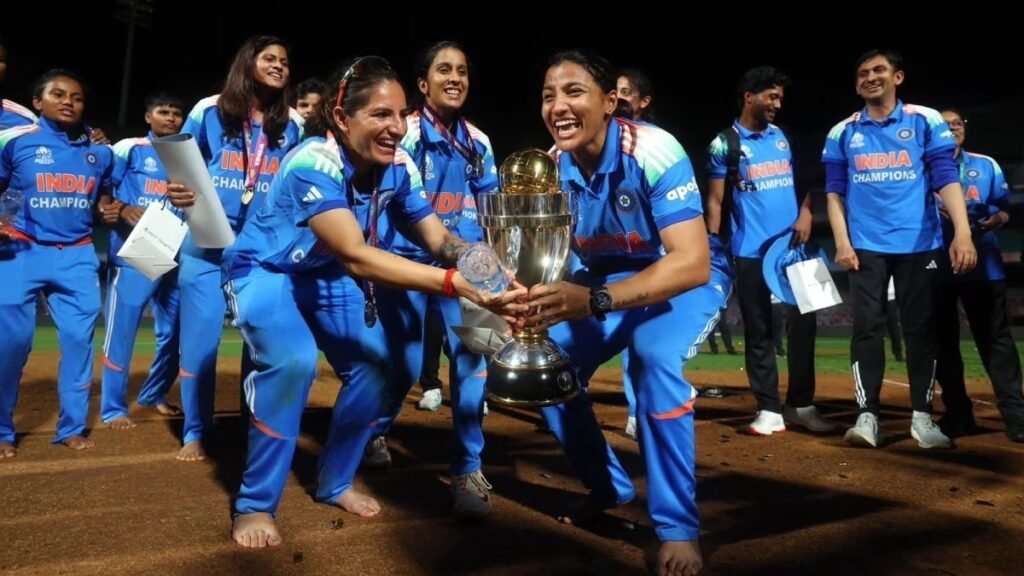
Renuka Thakur, who displayed early cricketing talent, faced limited opportunities following her father’s death when she was three. With scarce resources in her village of Parsa, her mother took a low-paying government job. At 13, Renuka’s uncle encouraged her to attend a residential academy by the Himachal Pradesh Cricket Association in Dharamshala, a pivotal decision that led to her becoming a key player in India’s recent World Cup victory.
Sunita emphasized the crucial role of the academy in developing a player who represented India and won the World Cup. Established in 2009, the academy, which offers specialized training for women’s cricket, has produced four international cricketers, including key members of the recent World Cup squad, Renuka and Harleen Deol.
Verma reflects on the significant impact of the academy in women’s cricket, stating that without its support, she wouldn’t have become an international cricketer. Today, the academy boasts over 20 players from 16 districts, covering Under-16 and Under-19 categories. Initially operating from a shared municipal ground, it has since relocated to an international-grade stadium in Dharamshala, offering stunning views of the Dhauladhar mountains.
From its inception, the academy has been led by Pawan Sen, a former First-Class cricketer turned coach. Initially, he took on multiple roles, ensuring the young female athletes transitioned safely from playing with tennis balls to tape balls and eventually leather balls. The academy’s first batch included two internationals, Verma and Renuka, but it started as a modest initiative until a pivotal moment occurred with the development of a stadium in Dharamshala. This sparked the ambition of the Himachal Pradesh cricket association to foster players for the national team. The breakthrough came in 2013 when wicketkeeper-batter Verma was selected for the Indian team, which encouraged more girls to participate. Following this, the association enhanced support by providing more playing opportunities and adding a trainer and physiotherapist. The efforts began to yield success, culminating in Harleen and Renuka making their debuts for India and achieving World Cup victories.
Four internationals, including two World Cup winners, emerged from a small academy in the hills, attributed to luck and the natural athleticism of young women living at high altitudes. A significant factor is the resolution of parental anxieties, particularly from those in small towns uncertain about a sports career. Sunita reflects on her weekly conversations with Renuka, who reported a sense of happiness, noting that the academy supported her throughout with food, nutrition, training, and school, creating a family-like environment.
Women cricketers require different management approaches than male players, as highlighted by Veena Pandey, a physical trainer at an academy. Understanding the emotional pressures young female athletes face is crucial for their development into champion players, with safety being a priority. This issue extends beyond cricket to all women’s sports in India, according to Verma. Sen notes increased difficulty in running the academy compared to a decade ago, due to fewer top cricketers produced and many trainees seeking job opportunities outside the academy, resulting in relocations for better playing chances.
With the introduction of the Women’s Premier League (WPL), children are increasingly pursuing professional contracts before representing their state, leading to greater parental involvement compared to before, which presents its own challenges. However, the success of two female players who won the World Cup could inspire more girls to take up the sport, which is a positive development for its growth.