
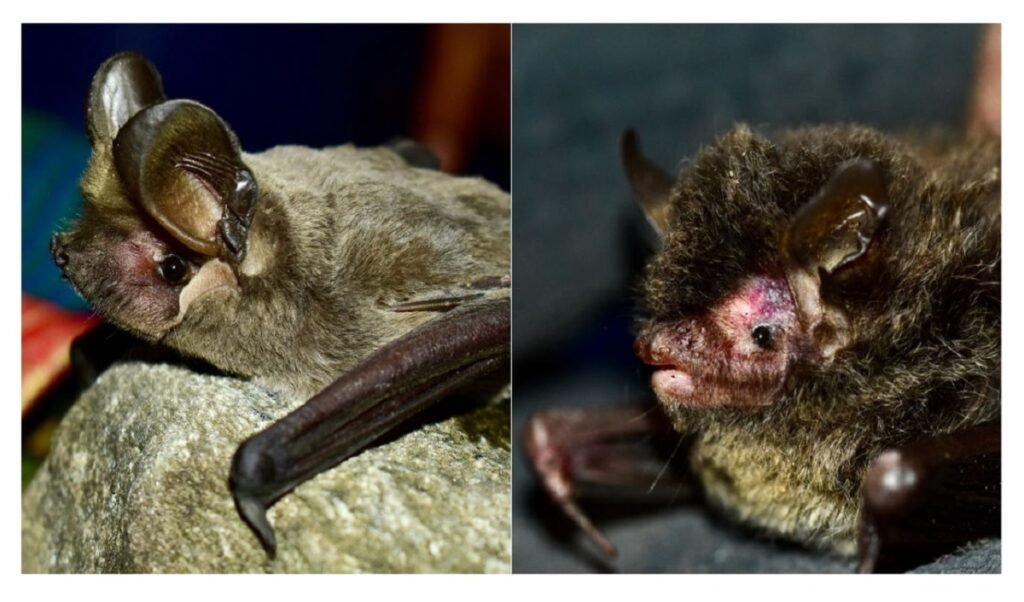
In an important scientific finding, researchers have discovered a rare species of woolly bat in Meghalaya, marking the first confirmed record of this bat in India. The species, known as Titania’s woolly bat, had never before been officially recorded within Indian territory. The discovery was made in the Khasi Hills of Meghalaya and has expanded the known range of this bat by nearly 500 kilometres towards the west. With this finding, India’s total number of recorded bat species has now increased to 137. Scientists say the discovery once again highlights how much of Northeast India’s wildlife remains unexplored.
The finding has been reported in a recent research paper published in the scientific journal Animal Taxonomy and Ecology. The study was carried out by a team of researchers including Uttam Saikia, Manuel Ruedi, Rohit Chakravarty, Jennifer Lyngdoh, Rajib Goswami and Gábor Csorba.According to the study, the bat was recorded during a field survey conducted in December 2024. A single male specimen was captured in a community-owned forest near Thankharang village in the East Khasi Hills district. The area lies at an elevation of about 870 metres above sea level and is known for its dense forest cover.The bat was caught around 7.30 pm using a two-bank harp trap that was set across a narrow forest path under thick tree cover. To increase the chances of capture, the researchers also used a specialised bat lure that played recorded ultrasonic bat calls. The team stated that the animal was handled carefully and strictly followed international ethical guidelines for wildlife research.
After the capture, the bat underwent detailed scientific examination. Researchers studied its body structure, teeth and skull measurements, wing shape, and echolocation calls. Genetic tests were also carried out using mitochondrial DNA analysis. All these methods together confirmed that the specimen belonged to Titania’s woolly bat.The study also included the first-ever description of the species’ baculum, or penile bone. Scientists say this is an important anatomical feature that will help future researchers better understand the species’ classification and evolution.For further confirmation, co-author Gábor Csorba compared the Indian specimen with the original reference specimen and 18 other samples collected earlier from Vietnam and Cambodia. This comparison helped strengthen the identification and removed any doubts about the species.Earlier, Titania’s woolly bat was believed to be found only in parts of Southeast Asia, including Myanmar, Thailand, Laos, Cambodia, Vietnam and China’s Yunnan province. Past reports from Taiwan and Hainan were later found to be cases of mistaken identity involving a closely related species.The researchers said that genetic analysis showed the bat belongs to a separate evolutionary group, different from similar species found in the region. The inclusion of the Indian specimen further supported this conclusion.