
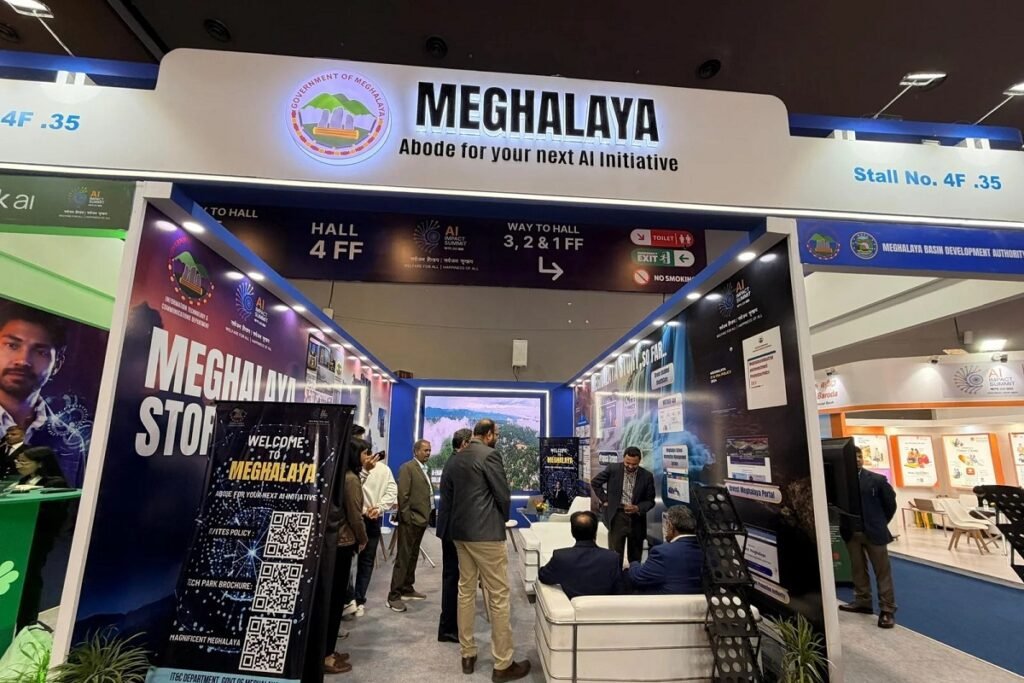
Meghalaya presented its growing use of artificial intelligence (AI) in governance, climate action, and rural development at the India AI Impact Conference held at Bharat Mandapam. The state used the national platform to show how technology is being used in practical ways to improve public services and support sustainable growth. Chief Minister Conrad K. Sangma described the participation as an important moment for the state. He said it was a proud occasion to see Meghalaya actively contributing to one of the largest gatherings focused on artificial intelligence. According to him, the event gave the state an opportunity to demonstrate how AI can be used not only for technological development but also for solving everyday governance challenges. The Meghalaya Pavilion at the conference brought together several government departments, research centres, and startups. Officials said this joint participation reflected a coordinated approach by the state rather than a symbolic presence. Among the organisations that took part were the IT & Communications Department of the Government of Meghalaya, the State GIS & UAV Centre under the Meghalaya Basin Development Authority (MBDA), the Climate Change Centre (MBDA), as well as private and startup partners such as Sirobilt, Shamrock AI, Ruralnomics, Edviseme, and the University of Science and Technology Meghalaya (USTM).
Representatives from the state explained that the pavilion mainly focused on showing how artificial intelligence is already being used on the ground. Demonstrations highlighted the use of GIS-based planning tools, drone-based monitoring systems, and AI-supported data analysis to improve development planning. These technologies are being used to track land use, monitor environmental changes, and support better decision-making by government departments. Officials also showcased how AI tools are helping farmers, small entrepreneurs, and rural communities. Advisory systems powered by data analytics are being developed to provide farmers with weather updates, crop-related information, and planning support. Similarly, AI-based solutions are being explored to assist small businesses and rural enterprises in improving productivity and market access. According to officials, these efforts are aimed at ensuring that technology reaches grassroots communities and does not remain limited to urban centres. Startups supported under the PRIME (Promotion and Incubation of Market-driven Enterprises) initiative also participated in the showcase. Their presence highlighted the state government’s effort to connect policy support with entrepreneurship development. By encouraging startups working in areas such as digital solutions, data analysis, and education technology, Meghalaya hopes to create a local innovation ecosystem that can generate employment and new business opportunities. Education and skill development were also key themes during the presentation. AI-based education platforms and training initiatives were discussed as tools to prepare young people for future job markets. Officials said the state is working to ensure that students and young professionals gain exposure to emerging technologies so that they can participate in the growing digital economy.
Chief Minister Sangma stated that Meghalaya’s participation in the conference was meant to show that smaller states can also play an important role in India’s technology transformation. He said the state is focusing on using artificial intelligence as a practical tool for governance reform, climate resilience, and inclusive growth. According to him, the objective is not only to adopt advanced technology but also to ensure that the benefits reach citizens in remote and rural areas.The Chief Minister also congratulated Prime Minister Narendra Modi for the successful organisation of the conference and thanked Union Minister for Electronics and Information Technology Ashwini Vaishnaw for providing states with an opportunity to present their work at a national platform. The India AI Impact Conference brought together policymakers, technology companies, startups, research institutions, and academic experts from across the country. Discussions at the conference focused on responsible scaling of artificial intelligence, ethical use of technology, and the integration of AI into public policy and governance systems.