
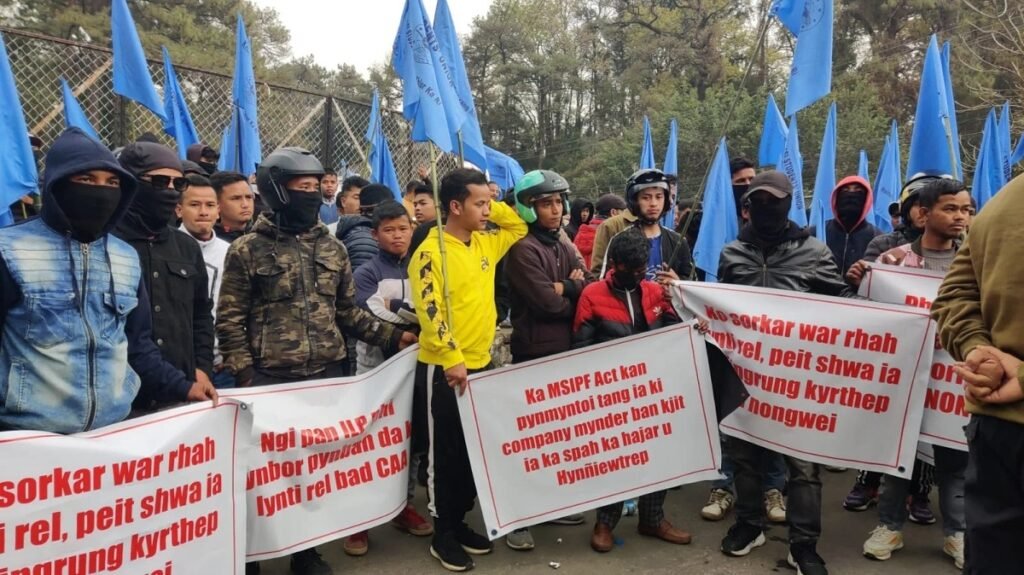
The Khasi Students’ Union’s (KSU) West Jaintia Hills District Unit has warned the Meghalaya government against the proposed railway project in Khasi Hills or future extension of tracks to Jaintia Hills, stating that railway connectivity would accelerate demographic changes and threaten the survival of indigenous Hynniewtrep communities. The student union’s warning comes in the wake of reports of a plan by the Northeast Frontier Railway (NFR) to conduct preliminary survey for the proposed 135-km Chaparmukh-Jowai new broad-gauge line as early as 2026.
“KSU has never compromised on the issue of railways from the very outset in 2008-09 till today. If the government forcibly tries to bring railways to Jaintia Hills, we will have no option but to physically defend our land and our future generations,” KSU West Jaintia Hills president Laitphar Syngkrem asserted at a media conference at the KSU office in Jowai on Wednesday. Syngkrem said that public sentiment across Pnar-dominated villages remains overwhelmingly hostile against any railway project. “If you visit any village in Khliehriat, Sutnga, Narpuh, or even Jowai town — you will find that no one wants the railway. The few who are favouring railways in the state are either politically motivated or stand to gain personally from land deals and contracts,” he alleged. The student’s union highlighted that Jaintia Hills has already witnessed significant non-tribal influx through the existing National Highway 6 corridor.
“The absence of Inner Line Permit (ILP) in Meghalaya — unlike Nagaland, Mizoram, and Arunachal Pradesh — is a major vulnerability. Despite repeated demands since 2013, successive state governments have failed to implement ILP or enact strong tenancy and land-transfer laws to protect tribal land ownership,” the KSU leader said. “If we do not stop the railway now, in the next three to four decades, the Pnar people will become a minority in their own districts, just as in parts of Shillong city and Ri-Bhoi,” Syngkrem warned, citing the rapid growth of non-tribal settlements in areas such as Lad Rymbai, Rymbai, and Lumshnong over the past two decades.