
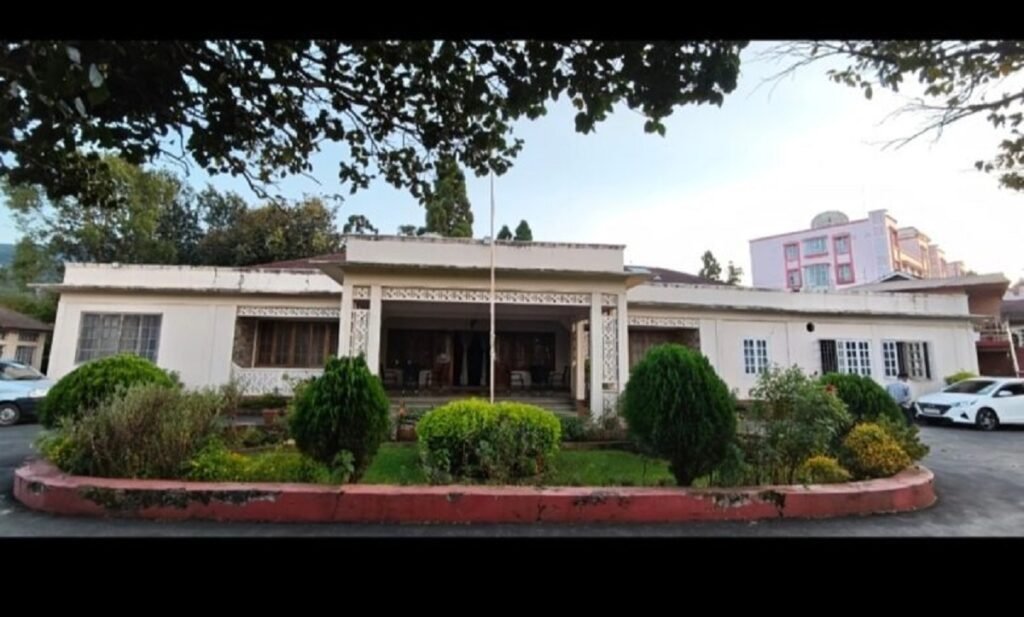
The Meghalaya High Court has directed the State Heritage Committee to submit a comprehensive report identifying all buildings, artefacts, structures and other elements covered under Section 3 of the Meghalaya Heritage Act, 2012. The Committee have also been asked to outline the steps taken so far for their restoration and preservation.
The directive was issued by a Division Bench comprising Chief Justice Soumen Sen and Justice H.S. Thangkhiew while hearing a Public Interest Litigation (PIL) concerning the proposed demolition of Bidhan Bhavan, also known as Roy Villa, which currently functions as a State Circuit House.During the hearing, the Advocate General sought additional time to file a detailed affidavit after reviewing official records relating to the history of Bidhan Bhavan and how it came to be used as a Circuit House.
The Court noted that the State already has a statutory mechanism under the Meghalaya Heritage Act, 2012, and reminded authorities of their duty to protect the region’s historical legacy.The Bench observed: “Every civilisation is known for its culture, which is best understood and appreciated through its creations—buildings, monuments and artefacts… Their preservation is essential for both present and future generations.”The Heritage Committee has been specifically asked to examine Bidhan Bhavan’s heritage value, which the Court said prima facie appears to be of historical significance. The State has been allowed time until February 5, 2026, to file its affidavit.Meanwhile, Malvika Bisharad, originally from Behala and now a long-time resident of Shillong, has emerged as a key figure in the campaign to save Bidhan Bhavan from demolition.
She highlighted the historical relationship between Shillong and the Roy family of Satkhira. Dr Bidhan Roy’s father, Prakash Chandra Roy, played a key role in promoting the Brahmo Samaj in the region. Dr Roy began building Bidhan Bhavan in Laban in 1920 and was instrumental in bringing electricity to Shillong.Calling the structure “not just a house”, she highlighted its deep historical roots. Built by Dr Bidhan Chandra Roy, one of the architects of modern Shillong, the house is associated with multiple cultural and national icons. Rabindranath Tagore visited the residence during his 1923 Shillong stay, and his birthday was celebrated there. Netaji Subhas Chandra Bose stayed in the house during his third visit to Shillong in 1929.Malvika submitted a memorandum to the Governor and personally approached Chief Justice Soumen Sen, handing over documents on the building’s historical importance.
Based on her representation, the High Court initiated the present PIL against demolition.Malvika has also urged the Chief Justice to visit other historically important sites in Shillong, including the Kelsal Lodge, where Netaji stayed, and the Battibazar house associated with Swami Vivekananda.She submitted archival documents and books detailing the connections of Tagore, Netaji, Dr B.C. Roy and Vivekananda with Shillong.Malvika also raised strong concerns about the deteriorating condition of Brookside Bungalow, another site associated with Rabindranath Tagore. She said, “Despite the Prime Minister’s Office recognising Brookside in 2023 as a heritage site named after Tagore—and even Chief Minister Conrad Sangma acknowledging the same—its heritage status has not been formally recorded. As a result, construction continues on the premises without proper oversight.”