
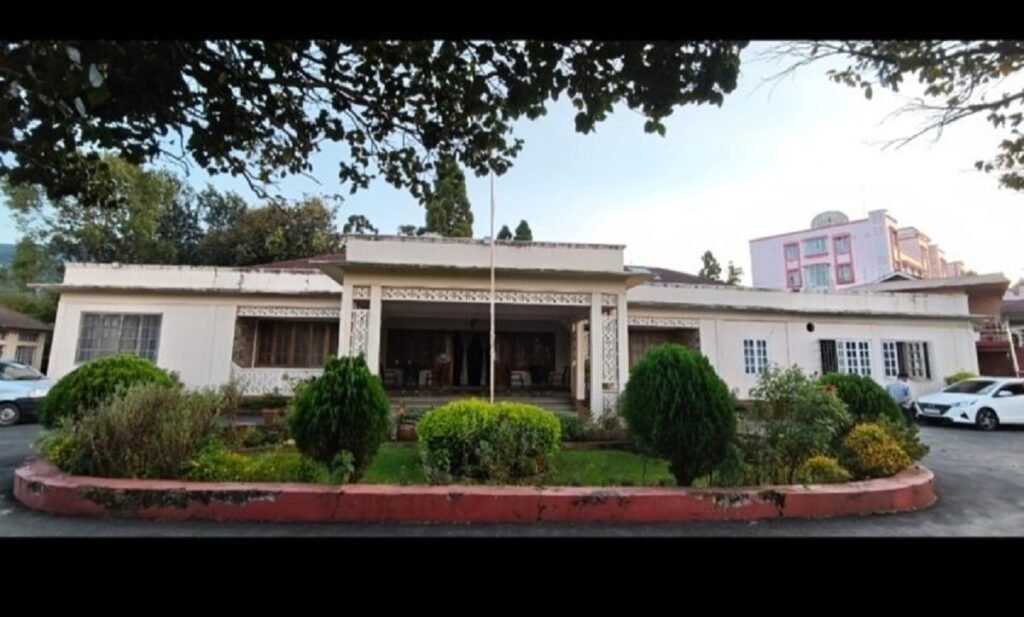
In a major development for heritage conservation in Meghalaya, the High Court has ordered status quo on the proposed demolition of the historic Circuit House in Laban, Shillong—also known as Bidhan Bhavan or Roy Villa—until further orders. The decision comes after a strong citizen-led campaign spearheaded by Malabika Bisharad, a Shillong resident originally from Behala, Kolkata, who has been actively raising concerns over the state government’s plan to raze the structure for a concrete expansion project. Earlier this month, the High Court registered a public interest litigation (PIL) based on a letter addressed to Chief Justice Soumen Sen. The letter described the Circuit House as a heritage site of immense historical importance. On Thursday, the matter came up for hearing before a Division Bench comprising Justice Hamarsan Singh Thangkhiew and Justice Biswadeep Bhattacharjee.
During the hearing, the state government filed a short affidavit. Advocate General Amit Kumar informed the court that a more detailed affidavit would be submitted after examining official records detailing the building’s history and its transition into a State Circuit House. Amicus Curiae S. Chakrawarty submitted that he would file his affidavit after receiving the state’s detailed response. The Bench directed that the matter be placed before the regular PIL bench headed by the Chief Justice and ordered that status quo on the property be maintained until the next date of hearing. Bidhan Bhavan, built by Dr. Bidhan Chandra Roy—one of the chief architects of modern Shillong and later the second Chief Minister of West Bengal—holds deep historical and cultural significance. The residence has hosted several iconic personalities, including Rabindranath Tagore, whose birthday was once celebrated there, and Netaji Subhas Chandra Bose, who stayed at the property during his 1929 visit.
Malabika Bisharad, who previously led efforts to save the Rabindra Smriti–linked Brookside Bungalow, intervened in this matter with similar urgency. She submitted a memorandum to the Governor and personally approached Chief Justice Soumen Sen with detailed documents highlighting the structure’s historical value. Her efforts prompted the High Court to take up the issue as a PIL. Following the court proceedings, Malabika expressed gratitude to the Chief Justice for considering the matter. She also urged him to inspect other neglected heritage structures in Shillong, such as Kelsall Lodge associated with Netaji and the deteriorating house in Batti Bazar where Swami Vivekananda once stayed. She alleged that many historically important buildings in the city have already been demolished without proper evaluation.
Along with her submissions, Malabika handed over rare documents and books related to Tagore, Netaji, Dr. Bidhan Roy, and Vivekananda to both the Governor and the Chief Justice, urging that Bidhan Bhavan be formally declared a heritage structure and preserved. The roots of the building stretch back over a century. Dr. Bidhan Roy began constructing the house in 1920 in Laban, while his father Prakash Chandra Roy had earlier played a key role in promoting Brahmo Samaj activities in Shillong. Dr. Roy later became a pioneer in establishing electricity supply in the hill city. Historical records confirm that Tagore visited the property during his 1923 stay in Shillong, and Netaji stayed there during his third visit in 1929.
The PIL has reignited the debate over heritage conservation in Shillong, where rapid urban expansion has often clashed with the need to protect historic structures. The future of Bidhan Bhavan now rests with the High Court, as residents continue to push for its preservation as a protected heritage site.